

Imagine your ship as a marathon runner. No matter how powerful and well-built he is, if his shoes are caked with mud, every step will feel heavier, slower, and more exhausting. That’s exactly what happens to vessels when marine growth—like algae, barnacles, and slime—takes hold of the hull. For ships calling in or operating from Denmark, underwater hull cleaning in Copenhagen has become an increasingly important part of ship maintenance and compliance.
Copenhagen’s waters play host to significant international trade, ferries, cruise liners, and cargo vessels. With such heavy traffic, the condition of each vessel’s hull has a direct impact not only on efficiency and operating costs but also on the port city’s broader environmental goals. If you’re a shipowner, manager, or operator, this is a practice you cannot afford to overlook.
In this article, we’ll dive deep into what underwater hull cleaning in Copenhagen really means, the technical aspects behind it, the environmental and regulatory landscape, the cost-saving potential, and the future innovations shaping this service.
What Is Underwater Hull Cleaning?
At its simplest, underwater hull cleaning in Copenhagen refers to divers or robotic systems removing fouling organisms from a vessel’s submerged surfaces. It’s typically carried out at anchor or berth without requiring dry docking.
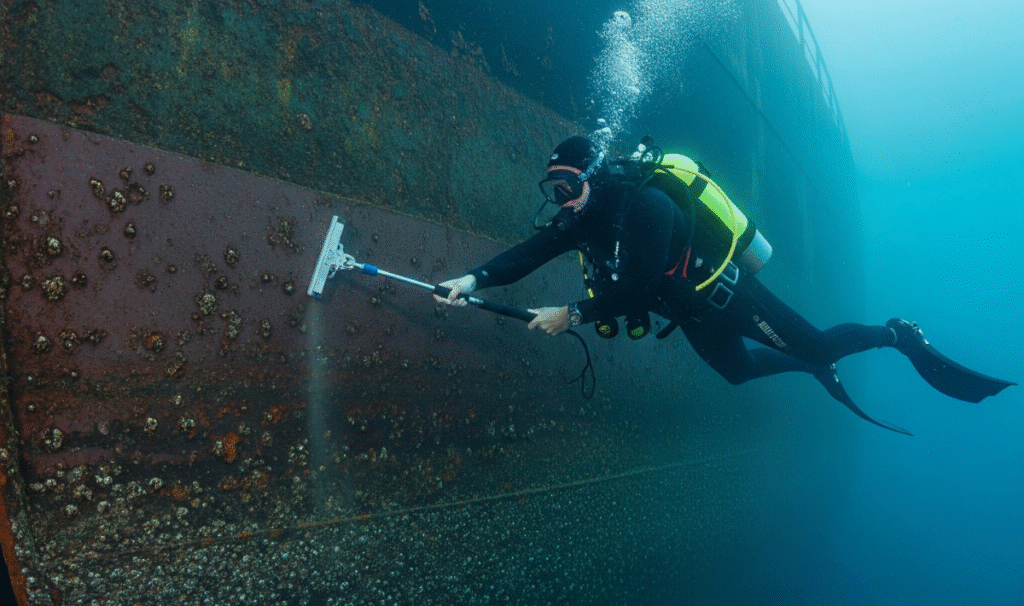
Biofouling occurs when ships remain in water for extended periods, as marine organisms colonize the hull. In Copenhagen’s temperate but busy waters, vessels are particularly prone to slime, algae, and hard fouling like mussels and barnacles. If left untreated, this not only reduces efficiency but also raises compliance concerns.
Why Copenhagen Is a Strategic Hub for Hull Cleaning
Copenhagen is not just a port of call—it’s a gateway to the Baltic, a region where environmental awareness is high and international shipping regulation is taken seriously. Shipowners increasingly choose underwater hull cleaning in Copenhagen because:
- The city’s location makes it a transit hub for Europe-Asia trade routes.
- Danish authorities support strict sustainability policies.
- Efficient hull cleaning at this port helps vessels meet emission targets before they enter emission-controlled areas (ECAs) like the Baltic Sea and North Sea.
Technical Aspects of Hull Cleaning Operations
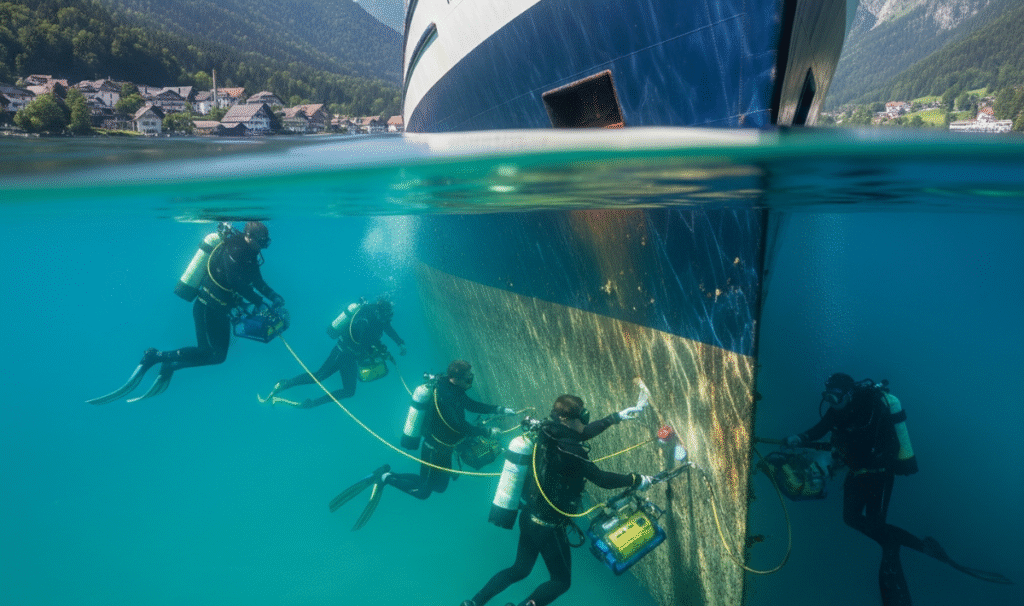
When we talk about underwater hull cleaning in Copenhagen, it’s not as simple as scraping off seaweed with a brush. Professionals employ highly specialized techniques:
Diver-assisted Cleaning
Divers equipped with hydraulic or pneumatic brush machines gently but effectively clean hull coatings without damaging protective antifouling layers.
ROV (Remotely Operated Vehicle) Cleaning
Some shipowners prefer robotic solutions. These underwater drones can perform hull cleaning missions with cameras, suction systems, and rotating brushes, ensuring precision even in difficult-to-reach areas.
Propeller and Niche Area Cleaning
Beyond the flat hull, rudders, propellers, sea chests, and thruster tunnels often accumulate fouling. Professionals include these hotspots in comprehensive cleaning operations.
Technical planning before underwater hull cleaning in Copenhagen often involves hull condition assessments, video inspections, and operational risk reviews.
Compliance and Regulation in Hull Maintenance
Regulatory standards play a massive role in why and how underwater hull cleaning in Copenhagen takes place. Authorities and associations, including the International Maritime Organization (IMO), International Chamber of Shipping (ICS), and IMCA, provide guidance to ensure safe, environmentally responsible operations.
MARPOL Convention
The MARPOL Convention (Marine Pollution), enforced by IMO, prohibits discharges that could harm the marine ecosystem. Improper hull cleaning methods that release antifouling particles or invasive species into Copenhagen’s waters would directly breach MARPOL.
Local Port Regulations
Copenhagen’s port authority insists on strict waste collection during hull cleanings. Sediments, biological matter, and paint residues are captured by modern filtration systems rather than allowed to drift into the harbor.
Failing to comply doesn’t just risk penalties—it threatens your ship’s ability to trade smoothly in international waters.
The Environmental Stakes: Protecting Baltic Ecosystems
One reason underwater hull cleaning in Copenhagen carries so much attention is its environmental dimension. Every ship captain knows that biofouling increases fuel consumption, but its consequences don’t stop there:
- Invasive Species Spread – A fouled hull can introduce non-native organisms from one port to another, creating ecological imbalances. Copenhagen, being a global transit hub, is very strict about minimizing this risk.
- Carbon Emissions – According to the IMO, a fouled hull can increase fuel consumption and greenhouse gas emissions by as much as 20–40%. Routine hull cleaning contributes directly to Denmark’s and Europe’s climate ambitions.
- Marine Pollution – By using recovery units and environmentally safe techniques, operators ensure that cleaning doesn’t release pollutants into Copenhagen waters.
In other words, your choice of underwater hull cleaning in Copenhagen extends far beyond your vessel—it’s a statement of accountability to the seas.
Cost Savings and Operational Benefits
Think of biofouling as an invisible hand constantly dragging your ship backward. When you reduce that drag through underwater hull cleaning in Copenhagen, the effects are immediate and measurable:
- Fuel Efficiency: A clean hull reduces resistance, cutting average fuel consumption by 5–10%. Over a year, that can translate into massive cost savings.
- Speed Recovery: Maintaining original cruising speeds becomes easier without pushing engines harder.
- Dry Dock Deferral: Routine in-water cleaning can extend dry-docking intervals, saving you hundreds of thousands in maintenance and downtime costs.
- Crew Safety and Predictability: A fouled propeller can cause vibrations and reduce maneuverability. Timely cleaning keeps operations smoother and safer.
When viewed against skyrocketing fuel prices and carbon taxes in Europe, underwater hull cleaning in Copenhagen is no longer just optional—it’s essential.
The Role of Advanced Hull Coatings
Underwater cleaning works best when paired with modern antifouling coatings. Many shipowners choose silicone-based or advanced foul-release coatings to complement the benefits of underwater hull cleaning in Copenhagen. The synergy between coatings and regular cleaning ensures that fouling never reaches costly, heavy stages of accumulation.
Innovations on the Horizon
The future of underwater hull cleaning in Copenhagen is being shaped by remarkable innovation:
- Autonomous Robotic Cleaners: These next-generation machines, already piloted in some Baltic ports, promise fully automated and data-rich cleaning operations.
- Data Integration: Hull inspections using AI can predict fouling growth patterns, allowing operators to schedule cleaning at the optimal time.
- Environmental Filtration Units: Improved capture systems are becoming standard, aligning Copenhagen’s operations with global best practices for ocean health.
- Digital Performance Monitoring: Fuel efficiency analytics linked to cleaning cycles create measurable benchmarks for shipowners.
Copenhagen, being at the forefront of sustainable port management, is expected to embrace these innovations rapidly.
Best Practices for Shipowners and Managers
If you are considering underwater hull cleaning in Copenhagen, here are some best practices:
- Plan cleaning intervals in line with your ship’s route, coating type, and fuel consumption.
- Always check that contractors adhere to IMO and local port waste management standards.
- Document hull inspections and cleaning records to demonstrate compliance.
- Integrate cleaning with performance monitoring for maximum ROI.
Conclusion: Keeping Copenhagen’s Waters—and Your Operations—Clean
A ship with a fouled hull is like a runner carrying a backpack full of bricks. You spend more energy, cover less distance, and risk long-term damage. That’s why underwater hull cleaning in Copenhagen is more than just maintenance—it’s about performance, compliance, cost efficiency, and environmental accountability.
By embracing modern cleaning techniques, working with certified professionals, and aligning with Copenhagen’s strict ecological standards, shipowners position themselves for both operational success and sustainability. Think of it as a partnership—between your vessel, the port, and the sea itself.
Similar market advantages are discussed in underwater hull cleaning in China.
FAQ:
Q1. How often should hull cleaning be done in Copenhagen?
It depends on trade routes and fouling accumulation, but on average, every 3–6 months.
2. Is underwater hull cleaning environmentally safe in Copenhagen?
Yes. Operators are required to use recovery systems and environmentally approved methods under MARPOL and local port rules.
3. What’s the cost-benefit of regular cleaning?
Fuel efficiency improvements (5–10%) and reduced dry dock intervals often offset cleaning costs within a few voyages.
4. Can robotic cleaning replace divers?
Not entirely yet, but robotic ROVs are increasingly used for safe and precise cleaning in difficult-to-access areas.
5. Why choose Copenhagen for underwater hull cleaning?
Copenhagen combines strategic location, strong regulatory compliance, and a sustainability-driven approach, making it an ideal hub for in-water cleaning.