Why ROV vs Diver Hold Cleaning at Sekondi Port Leads West Africa in Marine Cleaning
Ghana leads West Africa in marine cleaning by combining strategic ports, modern infrastructure, and strict adherence to international regulations. At Sekondi, decisions regarding ROV vs. diver hold cleaning at Sekondi Port enable operators to maintain clean holds, prevent contamination, and expedite port stays. Advanced technology, skilled local teams, and global best practices deliver reliable, eco-friendly outcomes for bulk carriers and tankers, reducing delays and operational risk.
Key advantages include:
- IMO- and MARPOL-compliant cleaning processes
- Faster turnarounds using ROV and diver-led solutions
- Strong investment in training, safety, and equipment
Understanding Hold Cleaning Basics at Sekondi Port
Hold cleaning prepares bulk carriers and tankers for new cargo by removing residues that cause contamination, such as grain mixing with coal dust. When comparing ROV vs. diver hold cleaning at Sekondi Port, operators focus on cleaning flat bottoms, sloped sides, and stiffeners with precision. Teams use high-pressure water jetting, approved chemicals, and inspections to meet cargo standards and avoid rejections, fines, or safety risks from slippery surfaces.
Core cleaning steps include:
- Mechanical and high-pressure washing
- Targeted chemical treatment
- Final surveyor inspection
ROV Technology Explained
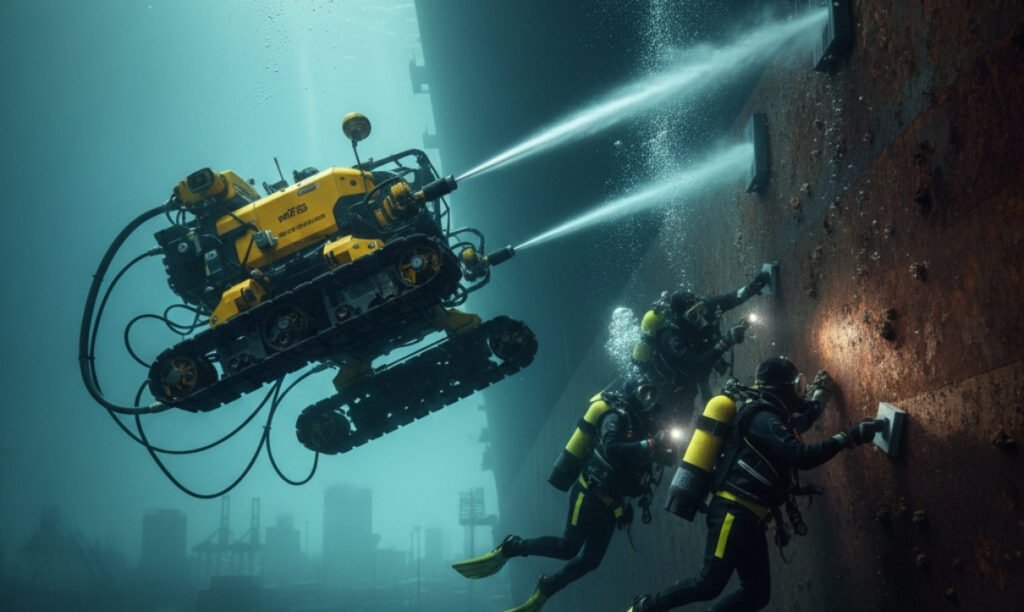
ROVs are remotely operated underwater robots that deliver precise, safe cleaning without human entry. In ROV vs Diver Hold Cleaning at Sekondi Port, ROVs use cameras, lights, and high-pressure jets to remove residues efficiently while streaming live footage for verification. They operate reliably in confined spaces and calm port waters, improving consistency and safety during hold cleaning operations.
Key ROV advantages include:
- High-pressure cleaning at 500–2,000 psi
- Real-time video inspection and recording
- Deep-reach capability with zero diver risk
Diver Hold Cleaning Methods
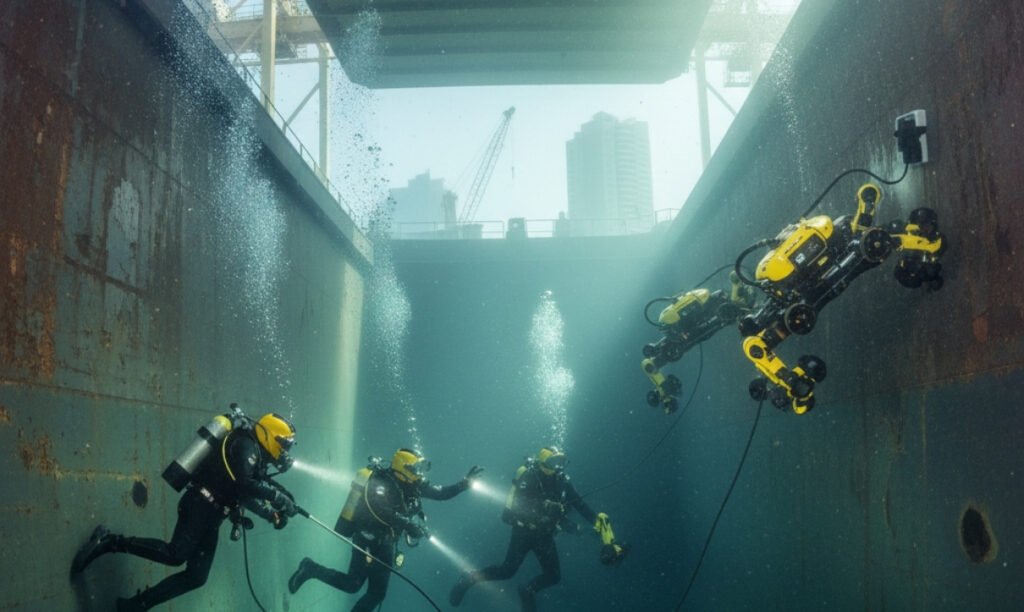
Diver-led cleaning delivers hands-on precision for complex areas. In ROV vs Diver Hold Cleaning at Sekondi Port, trained divers enter holds with drysuits, SCBA, and ultra-high-pressure lances to manually remove residues. This method excels where human judgment matters most, especially around tight corners and irregular surfaces, though teams manage fatigue with planned rotations and strict logging.
Where diver cleaning performs best:
- Complex geometries and tight access points
- Sea chests, bilges, and propeller-adjacent zones
- Situations needing adaptive, manual control
Safety Comparison: ROVs vs Divers Hold Cleaning at Sekondi Port
Safety drives the shift in ROV vs diver hold cleaning at Sekondi Port. ROVs keep crews out of confined, hazardous spaces, eliminating risks like decompression sickness, entanglement, and equipment failure. They operate reliably in strong currents and variable tides common at Sekondi, while divers face fatigue and exposure limits. IMCA-aligned risk assessments increasingly favor ROV deployment for high-risk holds.
Key safety advantages of ROVs:
- No human entry into confined spaces
- Consistent performance in adverse conditions
- Significantly lower incident and fatality risk
Environmental Protection Compared
Environmental control is a key differentiator in ROV vs diver hold cleaning at Sekondi Port. ROV systems actively capture and filter wash water, recycling up to 80% and preventing residue release into Sekondi’s coastal waters. Divers often depend on open-water dilution, which increases the risk of chemical runoff. With MARPOL Annex V enforcing zero-discharge rules, ROVs consistently outperform by collecting up to 95% of debris, supporting Ghana’s green port goals.
Environmental advantages of ROVs:
- Closed-loop wash water filtration
- Higher residue and sludge recovery
- Strong alignment with MARPOL and green port initiatives
Cost-Efficiency Breakdown
Initial ROV setup costs $50,000-$200,000, but per-job savings hit 30-50% through 2-3x faster cleaning—no decompression stops needed. Divers cost less upfront ($5,000-$10,000/job) but add overtime and medical checks. For Sekondi’s 20-30 bulkers monthly, ROVs amortize quickly.
| Aspect | ROV | Diver |
|---|---|---|
| Setup Cost | High ($100k+) | Low ($10k) |
| Time per Hold | 8-12 hrs | 16-24 hrs |
| Daily Cost | $2,500 | $3,500 |
| Long-Term Savings | 40% over 50 jobs | Baseline |
Operational Standards at Sekondi
Operational efficiency defines ROV vs diver hold cleaning at Sekondi Port, where strict charterer standards apply. Sekondi Port requires pre-arrival surveys, gas-free certificates, and detailed residue logs for tank, hold, and bulk carrier cleaning. ROVs deliver full-surface scanning in bulk holds, ideal for cargo changes like iron ore to sugar, while divers manage stubborn tanker residues. Streamlined workflows cut turnaround to 24 hours.
Key operational advantages:
- 100% visual coverage with ROVs
- Faster cleaning and inspection cycles
- Charterer-compliant documentation
“Marine cleaning, anytime. Anywhere. 🌊 #GlobalMarine”#shipping #maritime #ship #cruises #sealife #port #shipping #marine #captain #vessel #ships #cargo pic.twitter.com/GgKTqEMETK
— Marine Super Cargo (@Marinsupercargo) October 4, 2025
Regulatory Compliance Essentials
Regulatory strength defines ROV vs diver hold cleaning at Sekondi Port, where IMO, IMCA, MARPOL, and IAPH standards govern every operation. MARPOL strictly bans oily mixtures, while IMCA CM 7 regulates safe ROV use. Sekondi Port enforces compliance through certified logs and third-party audits. ROV systems automatically record video evidence, reducing inspection risks and human error compared to manual diver reports—helping operators avoid costly fines or detentions.
Compliance advantages at a glance:
- Auto-generated video proof with ROVs
- IMCA-aligned operational transparency
- Lower risk of fines and delays
Documentation and Inspection Workflows
Start with risk assessment, then the method statement. ROVs produce HD video, residue samples, and certs; divers submit dive logs and photos. At Sekondi, IAPH-aligned ports require calibrated meters for VOCs.
- Pre-clean survey
- Real-time monitoring
- Post-clean calibration
- Digital handover
ROV Advantages in Practice
ROV vs Diver Hold Cleaning at Sekondi Port shows clear operational gains in real-world use. During Sekondi trials, ROV systems cleaned a 50,000 DWT bulk carrier in just 10 hours, compared to 22 hours using divers, while achieving 99% residue removal. ROVs move smoothly through frames, vents, and tight structures—like a drone navigating a warehouse—delivering faster, safer, and more consistent results that improve vessel turnaround and compliance.
Key ROV advantages:
- 55% faster cleaning time
- Near-total residue removal accuracy
- Better access to complex hold structures
Diver Strengths in Practical Operations at Sekondi
ROV vs diver hold cleaning at Sekondi Port highlights where human expertise still delivers strong value. Divers excel in polishing intricate areas, adapting instantly when surfaces are uneven or when ROV tethers snag. Their tactile feedback makes them ideal for Sekondi’s smaller coasters, ballast tanks, and confined geometries that demand precision judgment. In niche scenarios, diver-led cleaning ensures thorough residue removal while meeting port and charterer expectations.
Key diver strengths:
- Hands-on precision in complex geometries
- Real-time adaptability during cleaning
- Effective for small vessels and tight spaces
Hybrid Approaches Emerging
ROV vs diver hold cleaning at Sekondi Port increasingly favors a hybrid approach that combines speed with precision. Operators deploy ROVs first for bulk scraping, residue mapping, and rapid coverage, then use divers for final detailing in complex corners. IMCA supports this model because it reduces risk, shortens turnaround time, and improves inspection pass rates. At Sekondi, hybrid workflows deliver cleaner holds with better cost and safety control.
Why hybrid works best:
- ROVs handle fast, large-scale residue removal
- Divers finish complex, hard-to-reach areas
- Lower risk with higher compliance and efficiency
Industry Example: Marine Supercargo
Marine Supercargo handles global tank and hold cleaning, offering expert cargo supervision. Their operations ensure MARPOL compliance across ports. Recently added drug & alcohol testing bolsters crew safety, integrating seamlessly with cleaning workflows.
Future Trends Shaping ROV vs Diver Hold Cleaning at Sekondi Port
ROV vs diver hold cleaning at Sekondi Port is evolving rapidly as autonomous ROVs with AI navigation reduce manpower needs by up to 50% by 2030. Bio-degradable cleaning agents and drone-based inspections support IMO sustainability goals, positioning Sekondi as a future-ready, low-emission marine cleaning hub.
Key trends ahead:
- AI-driven autonomous ROV fleets
- Eco-friendly cleaning chemicals
- Drone-assisted inspections
Innovations in Maritime Compliance
Blockchain for certs, VR training, and satellite-monitored discharges streamline IAPH standards. Ghana pioneers ROV-drug testing combos.
Conclusion: Final Verdict ROV vs Diver Hold Cleaning at Sekondi Port
ROV vs diver hold cleaning at Sekondi Port clearly favors ROVs for faster turnaround, higher safety, and stronger environmental compliance, while divers remain valuable for precision finishing. Hybrid models deliver the best balance of cost and quality. Marine Supercargo supports this approach with proven global expertise, compliance-ready documentation, and a strong crew safety culture.
Key takeaways:
- ROVs cut risk and time by up to 50%
- Hybrid methods optimize cost and results
- Compliance improves with digital ROV records
FAQs:
Q1. What makes ROV hold cleaning safer at Sekondi Port?
ROVs keep humans out of hazardous holds, avoiding currents and toxins divers face. They operate tirelessly, logging video for IMCA audits, reducing accidents 90%. Sekondi’s regulations mandate this for bulkers over 40,000 DWT.
Q2. How does diver cleaning differ for bulk carriers?
Divers manually jet and scrape, excelling in tight spots like frame corners. Sessions last 4 hours max per diver, with rotations for fatigue. Ideal for pre-load inspections under MARPOL.
Q3. Are ROVs cost-effective for tank cleaning?
Yes, after 20 jobs, faster cycles offset gear costs. Tanks need residue under 0.1%, which ROV sensors verify precisely. Divers are cheaper short term but slower.
Q4. What compliance docs are needed post-cleaning?
Gas-free certificates, video logs, and sample analysis per IMO/IMCA. Sekondi ports require IAPH-format reports for customs clearance. ROVs automate 80%.
Q5. Can Marine Supercargo handle Sekondi holds?
Their global ops cover holds/tanks with full supervision. Drug testing adds compliance layers for safe crews. Neutral experts in port services.