Ghana’s Edge in West African Marine Hold Cleaning Services in Ghana
Ghana dominates West Africa in marine cleaning services thanks to its powerhouse ports—Tema and Takoradi—handling over 18 million tons of cargo yearly. The Ghana Ports and Harbours Authority (GPHA) drives this with strict standards that keep vessels moving fast amid rising trade from bauxite to grains. You rely on these hubs as a trade gateway, where marine hold cleaning services in Ghana tackle urgent biofouling or hold residues to dodge demurrage fees.
Local expertise shines in rapid response; firms deploy divers 24/7 for hull scrubs or hold cleans during storms or delays. This proactive stance influences neighbors like Côte d’Ivoire, setting regional benchmarks for efficiency and eco-protection.
What Defines Emergency Marine Hold Cleaning Services in Ghana?
Emergency marine cleaning kicks in when routine maintenance fails—think heavy biofouling slowing a bulker by 20% or oily spills risking fines. These ops prioritize speed: Divers or ROVs mobilize within hours to ports like Tema, restoring performance before inspections halt loading. Picture a vessel idled by propeller tangles; emergency teams vacuum debris and polish blades, getting you back to sea.
In Ghana, urgency means weather-proof plans, with crews pre-staged for cyclone seasons. Standards cover hulls, props, sea chests, and holds, always containing waste to shore facilities—no ocean dumping.
Core Role of Diver-Led Services
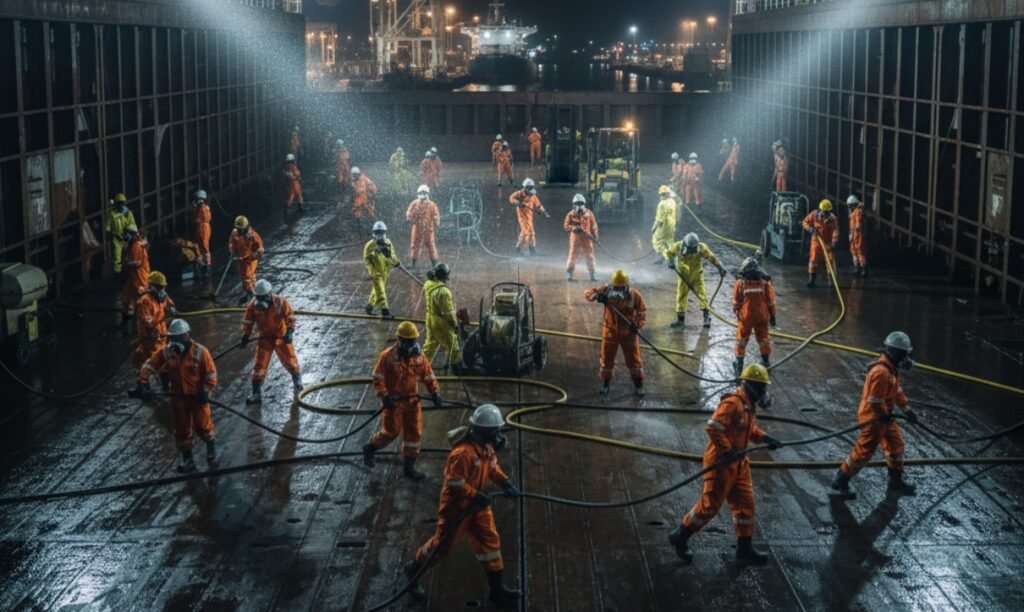
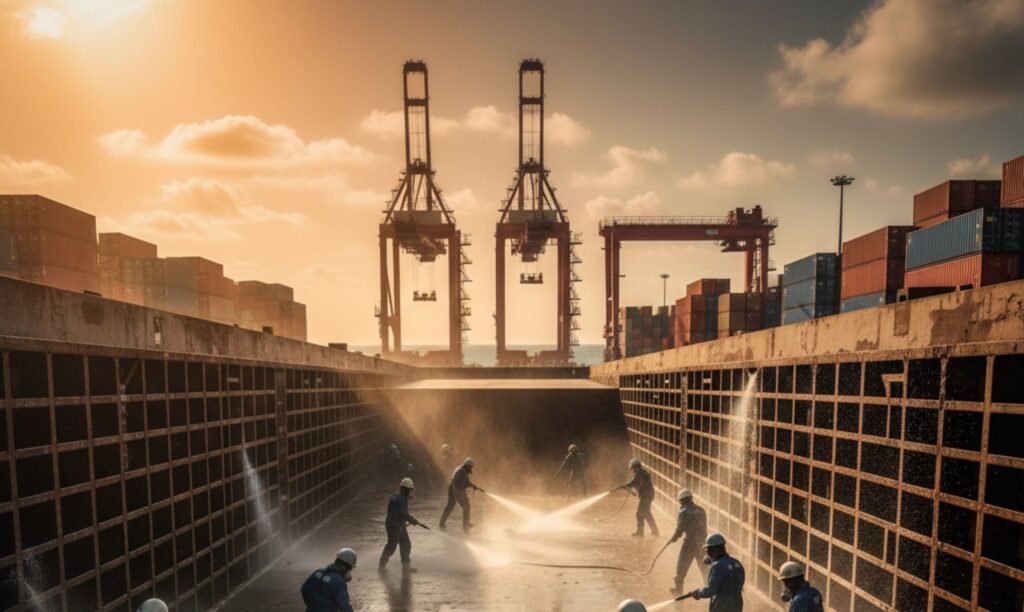
Divers excel in emergency marine hold cleaning services in Ghana, entering flooded holds or scraping hulls where tech lags. Surface-supplied air keeps them safe in 10-30m depths, blasting residues with 200-bar jets while topside tenders log every move. At Takoradi, they’ve cleared bauxite sludge from 5 holds overnight, prepping for cocoa loads.
You appreciate their adaptability—humans squeeze into frame corners ROVs miss, using scrapers for “hospital clean” finishes. IMCA training ensures they handle Ghana’s currents flawlessly.
ROVs in High-Stakes Scenarios
ROVs step up for zero-risk emergencies, tethered robots with HD cameras scrubbing hulls via brushes or cavitation. In Ghana’s murky Gulf waters, they map growth with sonar, cleaning nonstop for 8-hour shifts. Recent models like magnetic crawlers tackle holds too, spraying freshwater without chemicals.
Deploy one post-storm, and it clears intakes fast, logging video for insurers. Costly upfront, but they slash downtime in regulated ports.
Safety Protocols in Urgent Ops
Safety never bends in marine hold cleaning services in Ghana, even in a rush. IMCA mandates dive supervisors, hyperbaric chambers, and 2-diver teams; ROVs skip human hazards entirely. Ghana’s Maritime Authority enforces this, with local regs fining unsafe dives.
Real case: A Tema bulker’s fouled rudder—divers assessed risks first, using hot-water suits against chills. ROVs add fatigue-proof reliability, vital for night emergencies.
| Factor | Divers | ROVs |
|---|---|---|
| Human Risk | Medium (with protocols) | Zero |
| Emergency Speed | High precision | Continuous ops |
| Ghana Conditions | Handles currents | Visibility-proof |
Environmental Safeguards Under Global Rules
MARPOL Annex V and IMO garbage rules ban hold wash discharges near Ghana’s coast; emergency services capture 100% via vacuums to barges. IAPH pushes sustainability, with GPHA providing reception facilities. Divers bag solids; ROVs use closed-loop systems, protecting fisheries.
Ghana’s 2016 Maritime Pollution Act amps this, fining spills up to thousands of penalty units. Clean methods preserve mangroves, a win for all.
Cost Savings in Crisis Response
Emergencies hit wallets—fouling spikes fuel by 5-10%; fast marine hold cleaning services in Ghana recoup via quick turnarounds. Divers cost $5K-10K per job; ROVs $15K but finish 30% faster, cutting $20K demurrage. Hybrid teams optimize best.
In Tema, one urgent clean saved a vessel 2 days’ fees, proving ROI.
Regulatory Compliance Essentials
IMO, IMCA, MARPOL, and IAPH frame Ghana ops: Pre-clean surveys, waste manifests, surveyor sign-offs. GPHA audits logs; non-compliance delays clearances. Emergency workflows speed approvals with digital certs.
Marine Supercargo shows best practice, supervising global tank/hold cleans and adding drug & alcohol testing for safer crews.
Standards for Tanks, Holds, Bulk Carriers
Tanks need deslopping to 15ppm oil; holds hit grain clean (dry, residue-free) or table clean for foods. Bulkers prioritize tank tops and seams. Emergencies escalate to full scrubs.
- Grain clean: Rinse, vacuum, ventilate
- Hospital clean: Paint inspection everywhere
- Tank standards: Hot wash, inerting
Documentation and Inspection Flows
Start with risk logs, execute under video, and end with surveyor checklists. Ghana mandates MARPOL forms; tools like CleanShip.co track digitally. Post-emergency, certs release holds.
Workflow: Assess > Mobilize > Clean > Inspect > Report.
Ghana Port Success Stories
Tema urgent hull clean post-monsoon restored speed to an LNG carrier in 12 hours. Takoradi divers cleared a bulkers’ sea chests amid delays, averting $50K losses. These ops highlight Ghana’s readiness.
Innovations Shaping Urgent Marine Hold Cleaning Services in Ghana
AI ROVs predict fouling via hull scans; Ghana tests drone-diver hybrids. Biodegradable polishes and closed-circuit vacuums trend, cutting waste by 40%. Expect autonomous bots by 2030.
IMCA updates integrate data analytics for faster compliance.
Conclusion
In summary, marine hold cleaning services in Ghana stand out for three clear reasons. Ghana’s ports deliver fast, regulation-ready cleaning aligned with IMO and MARPOL standards. Strict safety and eco-focused methods protect crews, cargo, and coastal waters.
For urgent operations, hybrid cleaning models balance speed and cost efficiency. Partnering with experts like Marine Supercargo ensures dependable tank and hold cleaning, professional supercargo oversight, and advanced drug & alcohol testing—driving full compliance and operational excellence across every port call.
FAQs:
Q1. Why Prioritize Marine hold Cleaning Services in Ghana for Emergencies?
Marine hold cleaning services in Ghana excel for bulkers needing urgent hold or hull work, with GPHA-backed rapid response at Tema. Divers achieve grain clean fast, capturing residues per MARPOL, minimizing demurrage in trade hubs.
Q2. How Do Tanks Benefit from Emergency Cleaning?
Tanks get deslopped and gas-freed swiftly, using hot washes to meet 15ppm standards. Ghana teams handle oily sludge containment, ensuring safe loading post-inspection—vital for chemical carriers.
Q3. What Bulk Carrier Hold Standards Apply?
Bulk carriers require a shovel, grain, or hospital cleaning based on cargo. Emergencies focus on tank tops first, drying fully to prevent mold. GPHA enforces via surveys.
Q4. How Does Supercargo Support Cleaning Ops?
Supercargo verifies cleanliness, logs compliance, and liaises with surveyors. Marine Supercargo’s global experience includes tank/hold supervision plus drug & alcohol testing for crew safety.
Q5. What Future-Proofs Ghana’s Cleaning Services?
AI analytics and ROV autonomy speed responses, with eco-cleaners reducing impact. Ghana aligns with IMO trends for sustainable, efficient maritime ops.